
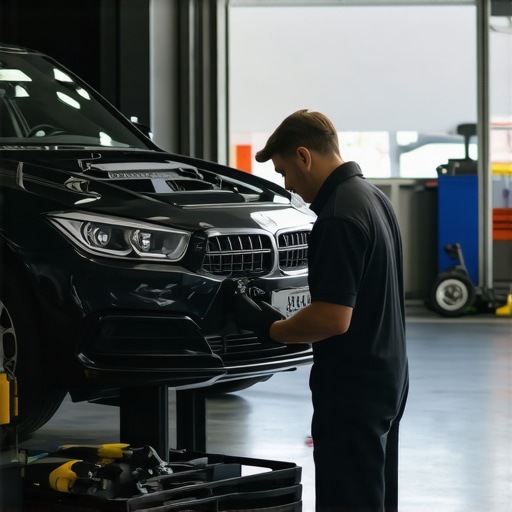
Why Your Car’s Safety Sensors Need a Reset After Any Front-End Work
In my two decades as an ASE Master Automotive Diagnostic Technician, I have seen the evolution of the automobile move from purely mechanical machines to sophisticated “computers on wheels.” Today, your vehicle is equipped with an invisible safety net known as Advanced Driver Assistance Systems (ADAS). These systems, which include Automatic Emergency Braking (AEB), Lane Keep Assist (LKA), and Adaptive Cruise Control (ACC), are designed to save lives. However, there is a critical misunderstanding in the world of collision repair: the idea that if a car looks fixed, it is safe to drive.
The reality is that even a minor “fender bender” or the simple act of removing a front bumper for a fresh coat of paint can disrupt the “eyes” of your car. These sensors – radar, cameras, and ultrasonic units – must be accurate to within millimeters. If they are even slightly misaligned, the safety systems you rely on can become a liability rather than a lifesaver. This is why ADAS calibration is no longer an optional “extra” service; it is a fundamental requirement of modern automotive repair.
What is ADAS Calibration?
To understand why a reset is necessary, we first need to define what ADAS calibration actually is. Calibration is the process of “re-teaching” the vehicle’s computer where its sensors are pointing in relation to the road and the vehicle’s physical centerline. Think of it like a professional athlete who has suffered a minor injury; even if the physical wound is healed, they may need to recalibrate their balance and coordination to perform at 100%.
There is a significant difference between the physical mounting of a sensor and its digital alignment. A technician can bolt a radar sensor back into its bracket, and the bumper cover can be snapped into place perfectly. To the naked eye, everything looks factory-fresh. However, the internal software of the car doesn’t know that the sensor has been moved. Without a formal calibration, the vehicle’s processor continues to operate using the spatial coordinates of the old sensor position. When you take your car to a professional auto repair shop, they use specialized software and hardware to sync the physical position of the sensor with the digital logic of the onboard computer.
Modern vehicles use three primary types of sensors for front-end safety:
- Radar Sensors: Usually located behind the grille or bumper, these use radio waves to determine the distance and speed of objects in front of you.
- Forward-Facing Cameras: Mounted behind the rearview mirror on the windshield, these “see” lane markings and traffic signs.
- Ultrasonic Sensors: These are the small circular “buttons” on your bumper used primarily for parking assistance.
Why Front-End Work Triggers a Reset
Many drivers are surprised to learn that a sensor doesn’t have to be broken to require a reset. In fact, many common repairs that seem unrelated to electronics can trigger the need for calibration. As we discuss in our guide on the truth about aftermarket vs OEM body panels, the structural integrity and fitment of front-end components are vital to how these sensors perform.
Common Triggers for Calibration:
- Bumper Removal: Even if the bumper isn’t replaced, removing it to access the radiator or for paint work can shift the mounting brackets of radar sensors.
- Grille Replacement: Many modern cars house the radar sensor directly behind the emblem or within the grille assembly.
- Windshield Replacement: Since the forward-facing camera is mounted to the glass, any new windshield – even an OEM one – requires the camera to be recalibrated to account for minute differences in glass thickness and angle.
- Radiator Support Repair: The “core support” is the frame that holds the cooling system and often serves as the mounting point for the vehicle’s primary safety sensors.
The Expert Insight: The 1-Degree Rule
In the world of diagnostics, we often talk about the “1-degree rule.” If a forward-facing radar sensor is tilted or angled by just a single degree, the error is magnified the further away the car looks. At highway speeds, a 1-degree misalignment can result in the car “seeing” an object 40 to 60 feet off-center. This means your car might think the vehicle in the lane next to you is actually in your lane, triggering a sudden, dangerous “phantom braking” event. Conversely, it might fail to see a stalled car directly in your path until it is too late.
The Critical Link: Wheel Alignment and Sensors
One of the most overlooked aspects of ADAS is its dependency on the vehicle’s mechanical alignment. If you are searching for an alignment near me, you are likely doing so because your car is pulling to one side or your tires are wearing unevenly. However, for a modern car, an alignment is the foundation of the entire safety system.
Most ADAS systems rely on the **Steering Angle Sensor (SAS)**. This sensor tells the car exactly how much the driver is turning the wheel. If your wheels are physically misaligned, the steering wheel might be slightly off-center while you are driving straight. This sends “bad data” to the camera and radar. The camera sees that you are staying within the lines, but the steering angle sensor tells the computer you are turning. This conflict can cause the Lane Keep Assist to malfunction or deactivate entirely.
While some DIY enthusiasts might look for how to check wheel alignment using a piece of string, this method is purely for emergency or diagnostic curiosity. It cannot provide the precision required for ADAS. A professional mechanic near me will use a 3D alignment rack to ensure the “thrust angle” – the direction the rear wheels are pointing – is perfectly aligned with the front. If the thrust angle is off, the car “crabs” down the road, making it impossible for the safety sensors to accurately track the vehicle’s path.
For more on why this matters, read our deep dive into why your steering wheel pulls toward the center line. Understanding the physics of your car’s movement is the first step in understanding why the digital sensors need a baseline of mechanical perfection.
Static vs. Dynamic Calibration: What’s the Difference?
When you take your car in for service, the technician will perform one of two types of calibration (or sometimes both), depending on the manufacturer’s specifications.
Static Calibration
Static calibration takes place inside the shop. It requires a highly controlled environment. The floor must be perfectly level, the lighting must be consistent, and there must be no reflective surfaces nearby. We use specialized targets – large boards with specific black-and-white patterns – and laser levels to position these targets at precise distances from the vehicle.
The vehicle’s computer is then put into a “learning mode” where it looks at these targets and adjusts its internal mapping. This is the most precise form of calibration and is common for brands like Toyota, Honda, and Mercedes-Benz.
Dynamic Calibration
Dynamic calibration is performed while driving the vehicle. However, this isn’t just a casual test drive. The technician must drive at a specific speed (usually between 25 and 60 mph) on a road with clear lane markings and a certain amount of “clutter” (like parked cars or signs) for the radar to recognize. Some systems require the technician to follow a lead vehicle at a specific distance for several miles. Brands like Ford and many General Motors vehicles often utilize dynamic calibration.
As an ASE Master Tech, I can tell you that dynamic calibration can be challenging. If it’s raining, snowing, or if the road markings are faded, the car may refuse to complete the learning process. This is why it’s vital to find a mechanic near me who has the patience and expertise to follow these OEM protocols to the letter.
The Danger of Skipping Calibration
The most dangerous thing about a misaligned ADAS sensor is that it often doesn’t trigger a warning light on the dashboard. This is a “silent failure.” You might drive for weeks thinking your car is fine, only to have the Automatic Emergency Braking fail when a pedestrian steps into the road.
The Insurance Institute for Highway Safety (IIHS) and various manufacturer studies (notably the “Honda Study”) have shown that even minor deviations in sensor mounting can lead to catastrophic system failures. In some tests, vehicles with uncalibrated cameras failed to initiate braking until after impact, or the Lane Keep Assist steered the vehicle into oncoming traffic because it misidentified the lane edge by several inches.
There is also the issue of liability. If a vehicle is involved in an accident and it is discovered that a required calibration was skipped during a previous repair, the shop and the vehicle owner could face significant legal consequences. Following collision renewal strategies that prioritize safety over speed is the only way to ensure long-term protection.
Cost, Insurance, and Professional Standards
One of the most common questions I get is: “How much does this cost?” Generally, ADAS calibration ranges from $249 to $500 per sensor, depending on the complexity and whether it requires both static and dynamic procedures. While this may seem like a high price for “software work,” the equipment required to perform these tasks costs tens of thousands of dollars, and the training required for technicians is extensive.
The good news for most drivers is that if the calibration is required as a result of an accident, insurance companies almost always cover the cost. Because calibration is a “required operation” by the Original Equipment Manufacturer (OEM), it is not considered an optional upgrade. It is a necessary step to restore the vehicle to its pre-loss condition. We emphasize these requirements in our essential car service checks to help owners understand that modern maintenance is as much about software as it is about hardware.
When choosing a shop, always ask if they provide a “post-repair scan” and a “calibration certificate.” These documents prove that the car’s systems were tested and verified as functional before the vehicle was returned to you. If a shop tells you that “the light isn’t on, so it doesn’t need a reset,” it is time to find a different auto repair near me.
Deep Dive: Sensor Technology and Its Vulnerabilities
To truly appreciate why a reset is necessary, we have to look at the physics of how these sensors work. Let’s take Radar (Radio Detection and Ranging) as an example. Radar works by emitting radio waves that bounce off objects and return to the sensor. The car calculates the time it took for the wave to return to determine distance. However, these waves are emitted in a very specific “field of view.” If the sensor is tilted downward by just a fraction of an inch, the radar waves hit the pavement too early. The car’s computer might interpret the road surface as a solid object, causing the car to slam on the brakes for no reason.
Cameras are even more sensitive. A forward-facing camera doesn’t just “see” an image; it interprets pixels to find patterns. It looks for the contrast between the white paint of a lane line and the black asphalt. If the camera is not perfectly leveled after a windshield replacement, the “horizon line” in its digital brain is tilted. This causes the Lane Departure Warning to trigger prematurely on one side and fail to trigger at all on the other.
Then there is LiDAR (Light Detection and Ranging), which is becoming more common in high-end vehicles. LiDAR uses laser pulses to create a 3D map of the surroundings. Because LiDAR operates on light pulses, even a slight smudge or a microscopic scratch on the sensor cover (or the portion of the bumper it looks through) can refract the light, creating “ghost objects” in the vehicle’s path.
Conclusion: Trusting the Experts
Your vehicle’s safety systems are only as good as their last calibration. In the modern era of automotive repair, the “wrench and hammer” approach is no longer enough. We are now in the era of “lasers and logic.” Whether you’ve had a major collision or a simple bumper repair, ensuring your ADAS sensors are reset to OEM specifications is the only way to guarantee the safety of yourself, your family, and others on the road.
Don’t leave your safety to chance. If your car has been in the shop for front-end work, make sure to visit a qualified auto repair near me to verify that your invisible safety net is fully functional. Remember, a car that looks like it’s fixed isn’t truly repaired until its brain is back in sync with its body.
Stay safe on the road,
Nate Barnhurst
ASE Master Automotive Diagnostic Technician
ADAS Programming and Calibration Specialist